What Is A Galvayne's Groove?
A Galvayne's groove is a dark or brownish groove in the upper corner incisor teeth of horses. It is only visible in horses of a certain age.
Depending on whether or not a Galvayne's Groove can be seen, how long it is, and where it is (at the top of the tooth or at the bottom) it may be helpful in determining a horses' age.
Determining the age of a horse by its teeth must take into account a wide variety of factors, but even then there are many horses whose age cannot be accurately determined by their teeth.
Simply put, while there are guidelines about how teeth should look in a horse at any given age, teeth sometimes lie. Environmental factors, diet, management practices, breed, individual variances, age (it is generally more accurate to age a horse younger than age 9 by its teeth than an older horse), and more can all cause a horse's teeth to inaccurately represent how old a horse actually is.
Below: Photo of a Galvayne's groove in a 14 year old horse.
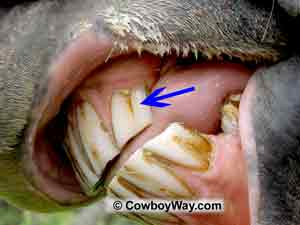
When using teeth to try to determine the age of a horse older than 10 years, the Galvayne's groove is one of the indicators many horsemen will use.
In the text and photos below we explain what a Galvayne's groove is, show several photos of Galvayne's grooves in different horses, and explain what it is expected (but not guaranteed) to look like when a horse is a certain age.
The Galvayne's Groove - The Basics
As we said above, the Galvayne's groove is a dark or brownish groove in a horse's upper corner incisor teeth. If present, it should be present on each side of a horse's mouth.
In general, the Galvayne's groove:
- First appears at the gum line in horses about 10 years of age. Each year, the groove will extend a little farther down the tooth.
- It is expected to be about halfway down the tooth at 15 years of age, and all the way down (visible from top to bottom) at 20 years of age.
- After 20 years of age, the Galvayne's groove begins to disappear from the tooth, starting at the top. By approximately 25 years of age the Galvayne's groove will be gone from the top half of the tooth, but still visible on the bottom half.
- By the time a horse is 30, it is expected to be gone completely.
Photographs Of Galvayne's Grooves
Below are photographs of Galvayne's grooves in four different horses.
Please keep in mind that a Galvayne's groove alone is often a poor indication of a horse's age and should be used, when aging horses by their teeth, only in combination with other factors.
This is photograph of an upper corner incisor in a 5 year old Quarter Horse mare. A Galvayne's groove is not visible. That isn't surprising since a Galvayne's groove is not expected to begin showing until a horse is approximately 10 years old.
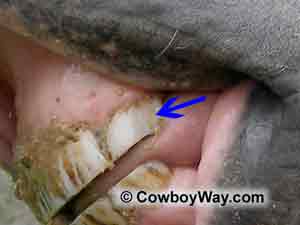
This is photograph of a Galvayne's groove in a 14 year old Quarter Horse gelding. It is almost halfway down the tooth.
Since a Galvayne's groove is expected to first be visible at the top of the tooth around age 10, and to extend about halfway down the tooth at age 15, this horse's groove is representing his age accurately.
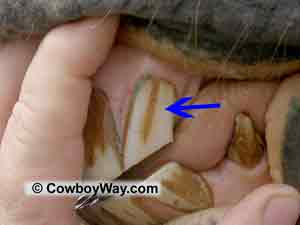
This is a Galvayne's groove in a 26 year old one-half Quarter Horse, one-half Belgian gelding.
According to the the generally accepted theories regarding the groove, this one is not representing the horse's age accurately and is indicating he is younger than he actually is.
By age 20 the groove should extend all the way from the top of the tooth to the bottom, and at age 26 this horse's groove still hasn't reached the bottom.
In addition, after age 20 the groove is expected to begin to disappear from the top of the tooth, and this horse's groove is still clearly visible at the top.
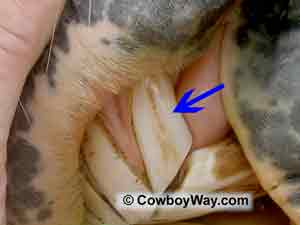
This is a Galvayne's groove in a 26 year old Quarter Horse mare.
Similar to the horse immediately above, the groove alone is not indicating her age accurately and is making her appear younger than she actually is.
Her Galvayne's Groove has barely reached the bottom of her tooth and is still clearly visible at the top. Using the Galvayne's groove alone, you would guess this mare to be about age 20.
Galvayne's Groove - Splitting The Difference
Interestingly, Galvayne's grooves might not be identical in a horse when comparing the upper corner incisor tooth on one side of its mouth to the one on the other side.
In this case, it is generally considered a good idea to assume the age is somewhere between what each groove is indicating.
For example, if the Galvayne's groove on the incisor on one side of a horse's mouth is about half-way down from the top (indicating the horse is 15 years old) but the incisor on the other side is only about a quarter of the way down (indicating the horse is 12 and-a-half), you would probably guess the actual age to be older than 12 but younger than 15.
In Closing...
When it's all said and done it can be interesting to try and age a horse by its teeth, including looking at the Galvayne's groove.
Relying on the age indicated by a horse's teeth, however, particularly in horses older than about age 9, can at best be an educated guess.
Where The "Galvayne's Groove" Got Its Name
The Galvayne's groove got its name from Sidney Galvayne, a 19th-century horseman born in Australia who gained recognition as an excellent judge of a horse's age by examining it's teeth while traveling Europe in the 1880s.
What Is / Are...
… What Are 5 Of The Biggest Wild West Robberies?
… What Are 5 Reasons Horse Trailer Lighting Matters?
… What Are 8 Dumb Things To Say To A Horse Lover?
… What Are 9 Proven Ways To Keep Flies Off Horses?
… What Are Chestnuts and Ergots?
… What Are The Parts Of A Western Saddle?
… What Are Saddle Rigging Positions?
… What Are Some Fencing Options?
… What Are Some Foods Both Horses And Dogs Can Eat?
… What Are Some Horse Fencing Basics?
… What Are Some Interesting Horse Facts?
… What Are Some Interesting Charts and Graphs With Horse Information?
… What Are Some Options For Temporary Horse Fencing?
… What Are Synthetic Saddles Made Of?
… What Are The Rodeo Catch Pens?
… What Are The 10 Best 3-Horse Trailers With Living Quarters In The USA And Canada?
… What Are The X's In A Cowboy Hat?
… What Are The Three Legal Head Catches?
… What Is The Angle System For Branding?
… What Is The Barrel Racing Pattern?
… What Is A Bull Riding Vest Made Of?
… What Is Deworming Your Horse?
… What Is A Domain Name?
Why would I need one for my farm or ranch even if I don't have or
want a website?
… What Is A Fifth Wheel Trailer Hitch?
… What Is Flag and National Anthem Etiquette At A Rodeo?
… What Is A Slant Load Horse Trailer?
… What Is Floating A Horse's Teeth?
… What Do Horse Freeze Brands Look Like?
… What Is A Galvayne's Groove?
… What Is A Gooseneck Trailer Hitch?
… What Is Some History About The First National Finals Rodeo?
… What Is The History Of The Modern, Hornless, Bronc Riding Saddle?
… What Is The History Of The Modern Rodeo Bucking Chute?
… What Is The History Of The One-Hand Bareback Rigging?
… What Is The Nasolacrimal Duct In Horses?
… What Is A Pony Express Mochila?
… What Is Hermann Oak Leather?
… What Is Larvicidal De-Worming?
… What Is The Flehmen Response?
… What Is The Rodeo Return Gate?
… What Is A Safety Tip For Posting The Colors?
… What Is A Slick Fork Saddle?
… What Is A Swell Fork Saddle?
You Might Also Like