What Are Some Interesting Horse Facts?
This page is bursting with interesting facts and trivia about horses.
Below you can find all kinds of interesting facts about equine vision, height, teeth, splint bones, and even horse birthdays!
Horse Vision
- The horse has one of the largest eyes of any land mammal.
- A horse can see better at night than a human. However, it takes a horse's eyes longer to adjust from light to dark and from dark to light than a human's.
- Horses are not color blind. They have what researchers call "dichromatic"
vision, or "two-color" vision.
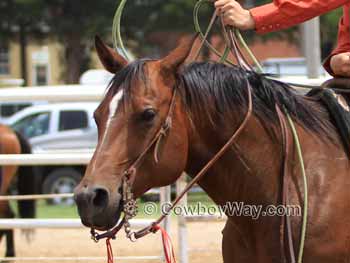
Research indicates horses can perceive blue and green tones, and color variations based on them. However, they have difficulty with other colors, including reds. - Most of the time, a horse has "monocular" vision. This means a different image is seen by each eye so that a horse is seeing two different pictures at the same time.
Most of the time, wherever a horse's ear is pointing is where the horse is looking with the eye on the same side. If the ears are pointing in different directions, the horse is looking at two different things at the same time.
There are exceptions to this. For example, if a horse has its ears pinned back against its neck in anger, this does not mean it is looking backwards with both eyes.
Below: This horse is looking forward with his right eye, and back with his left eye.
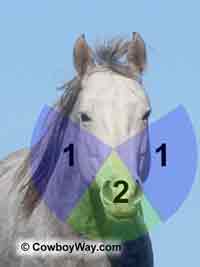
- A horse can also have "binocular" vision. Binocular vision is when both eyes work together to see one picture (humans have binocular vision). A horse only has binocular vision when it is looking down its nose.
- A horse has a wide range of vision. A horse can see completely around its
entire body except for small blind spots directly in front of its face,
underneath its head, and directly behind itself.
This is why it's very important not to walk up right behind a horse - you are in its blind spot and if you startle it you may get kicked.
Below: The areas with a #1 shows where a horse has monocular vision. The area with a #2 shows where a horse has binocular vision.
A Horse Is A Horse When...
- A horse is usually not considered to be a "horse" until it is 5 years old. Before that, males are known as colts and females are known as fillies. However, it is still acceptable to call a colt or filly a horse.
- A foal is a very young horse and can be either male or female.
A Horse Has A Frog......Four, Actually
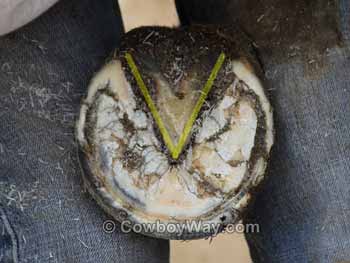
On the underside of a horse's hoof is a triangular shaped area called the "frog." When pushed on the frog has a firm, rubbery feel that yields to pressure.
Each time the frog comes into contact with the ground it acts as a shock absorber for a horse's leg, and also helps to pump blood back up the leg.
A healthy, functioning frog that makes good contact with the ground is vital to the hoof and leg health of a horse.
Below: The yellow highlights outline the frog.
Horses Are Ungulates
A horse is an ungulate, which means it is a mammal with hooves.
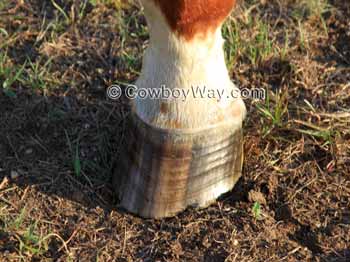
Horses have one hoof at the end of each leg, which makes them odd-toed ungulates. Cattle have two hooves at the end of each leg, which makes them even-toed ungulates.
Below: A horse hoof.
Horse Facts: Height
- Horses height is measured in units known as "hands." One hand is equal to four inches.
- A horse is usually considered to be 14.2 (14 hands, 2 inches) or taller when mature.
- Anything under 14.2 when mature is usually considered to be a pony.
- We have a more detailed article on horse height here.
Flehmen Response
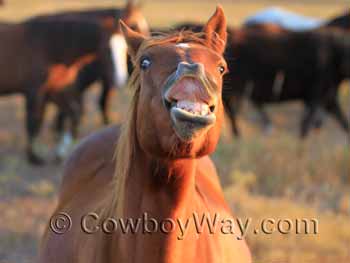
The Flehmen response is a posture sometimes exhibited by certain mammals, including horses, when they encounter an interesting or stimulating scent.
The Flehmen response is characterized by a raised, extended neck and head, along with a raising and curling of the upper lip, usually exposing some upper teeth.
For more information about the Flehmen response in horses, please see this page: What Is The Flehmen Response?
Below: A mare showing the flehmen response.
Coronary Band
The coronary band (sometimes also called the cornary band or coronet band) is a band of tissue circling a horse's leg just above the hoof.
The coronary band is the source from which the hoof wall grows. An injury to the coronary band can sometimes result in irregular hoof growth and/or an unsound hoof wall.
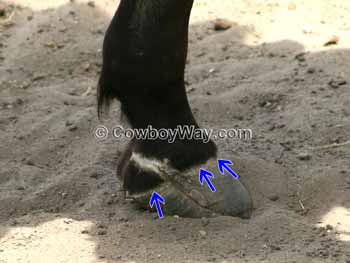
In the photo below you can see that this mare's leg has a scar resulting from a deep cut that extended into the coronary band. In this case, even though the growth of the hoof wall was affected, she was sound for light use.
Below: The blue arrows point to the coronary band circling the hoof.
Advertisement
A beautiful cowhide purse / From Etsy
BLM Brand
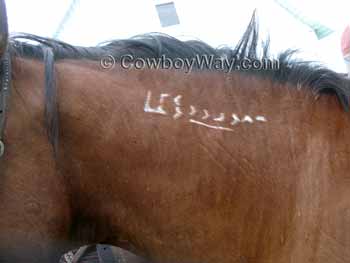
A BLM brand is a brand placed on an animal by the United States Bureau of Land Management (BLM). It is probably best known as the brand used on BLM horses (aka "mustangs"). The brand uses a system known as the "angle system" to create the numbers 0-9 with only two characters.
We have a lot more information on BLM brands, including how to read them, here: What Is The Angle System For Branding.
Below: A BLM brand on a horse.
Horse Facts: Teeth
- Adult female horses (mares) usually have 36 teeth.
A mare may have up to 40 teeth if she happens to have any canine teeth,
which is possible but less common.
Adult males have between 40 and 44 teeth. (These figures do not include wolf teeth.)
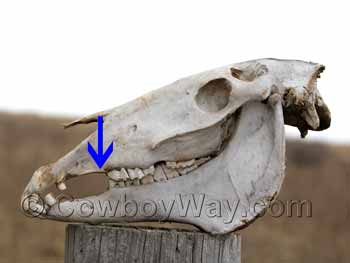
- "Wolf teeth" in horses are teeth that are vestigial premolars. "Vestigial"
means something that has lost most or all of its original function through
evolution.
Wolf teeth are usually just on the upper jaw, but are sometimes found on the lower jaw, too. They are not present on all horses, but are nonetheless not uncommon.
Wolf teeth can be a serious nuisance and most horsemen have them removed. Since wolf teeth typically have poorly developed roots, they are usually quickly and easily removed.
For more information on wolf teeth, including photos of extracted wolf teeth, please see this page: Wolf Teeth.
Below: There are no wolf teeth on this horse skull. However, the blue arrow is pointing to the approximate location where a wolf tooth would be found.
- Adult horses have teeth that are several inches long. Most of the tooth
cannot be seen because it is below the gum line.
Little by little the teeth erupt through the gum to replace the surface of the teeth as they are worn down. - It is common for the grinding surfaces of a horse's teeth to become uneven
and sharp, greatly reducing its ability to properly process food and also
possibly cutting the horse inside its mouth.
For that reason a horse's teeth should be periodically checked to see if they need floated (filed so that the grinding surfaces become level and smooth again).
- A horse's upper jaw is wider than its lower jaw. Because of this, during normal chewing sharp edges frequently form along the outside edge of the upper teeth, and the inside edge of the lower teeth. This is another good reason a horse's teeth should periodically be checked to see if they need floated.
- A horse's age can usually be accurately determined by its teeth until
the horse is about 9 years old.
After that, a horse is known as "smooth mouthed" or "aged" and it becomes more difficult to accurately estimate its age by its teeth. - The "interdental space" is an area in a horse's mouth, both on the upper
and lower jaws, where there is not any teeth. This area is between the front
teeth (the incisors) and the back teeth (the molars).
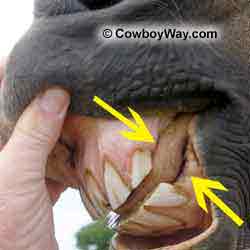
When a horse is bridled, the interdental space is where the bit rests. On the bottom jaw, most horsemen refer to this area of bare gums as the "bars." In the photo below, the yellow arrows are pointing to the interdental space.
Below: The interdental space.
- "Floating" a horse's teeth means to file or rasp their teeth. This is done
to make the chewing surfaces relatively flat or smooth, and to prevent sharp
edges from forming and cutting the inside of the horse's mouth.
The type of file used for this is called a "float," which is where the procedure gets its name. We have more information on floating a horse's teeth here.
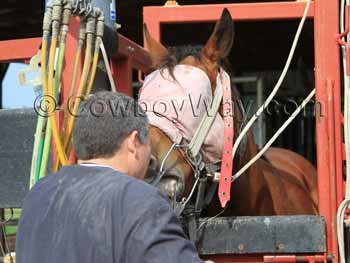
In the photo below you can see a horse getting its teeth floated. This particular horse is handled very seldom and is therefore is stocks, blindfolded, and lightly sedated. This is for the protection of both the horse and the veterinarian performing the procedure. An equine dental speculum is keeping the horse's mouth open. The veterinarian will file, or float, the teeth on both the upper and lower jaws.
Below: A horse getting its teeth floated.
Horse Terms
- Colt - A young male horse, 4 years old or younger. The word "colt" is also sometimes used more casually to refer to a young horse that is male or female.
- Filly - A young female horse, 4 years old or younger.
- Foal - A newborn or very young horse, male or female.
- Gelding - A male horse that has been castrated, or gelded.
- Horse Colt - Another way of saying "colt," which is a young male horse, 4 years old or younger. In casual conversation some people refer to any young horse, or a young horse of unknown gender, as a "colt," so the term "horse colt" is sometimes used to make sure there is no misunderstanding that the young horse is a male.
- Mare - A mature female horse.
- Stallion - A male horse that has not been castrated.
- Dam - The term give to a female horse when she becomes a mother.
- Sire - The term given to a stallion when he becomes a father.
Chestnuts
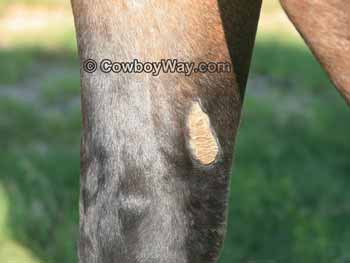
Horse chestnuts are normal, healthy growths found on most horse's legs.
Chestnuts appear on the front legs of a horse above the knee, or on the back legs of a horse below the hock. They can be large or very small.
Some people call horse chestnuts "night eyes."
For more information about horse chestnuts, please see our article What Are Horse Chestnuts and Ergots?
Below: A horse chestnut above the knee.
Inside A Horse
- The horse has one stomach. In contrast, cattle, sheep, goats, bison, deer, elk, caribou, moose, and camels are "ruminants" which means (among other things) they have four digestive chambers instead of just one stomach.
- The horse is an herbivore, which means it feeds mostly on plants.
- The normal horse’s small intestine is about 70 feet long.
- The normal horse's large intestine is about 12 feet long.
- The average horse's heart weighs approximately 9 or 10 pounds. The great New Zealand / Australian racehorse, Phar Lap, had a heart that weighed 14 pounds. The great American racehorse Secretariat had a heart estimated during his autopsy to weigh 21 pounds, though the heart was not weighed.
- Horses produce approximately 10 gallons of saliva a day.
Advertisement
Custom made horse cutting board / From Etsy
Ermine Spots, aka Ermine Marks
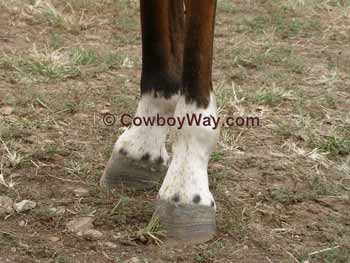
Ermine spots (also known as "ermine marks") are black or dark spots that appear in white markings just above the hoof. For more information about ermine spots, you can see this page: What Are Ermine Spots?
Below: A horse with ermine spots, or ermine marks.
Horse Records
- The tallest horse on record was a Shire named Samson. He was 21.2 hands (7 feet, 2 inches) tall. He was born in 1846 in Toddington Mills, England.
- The oldest horse on record is "Old Billy," an English barge horse. He was 62 years old when he died, living from 1760 to 1822.
- The record for the highest jump made by a horse is held by a horse named Huaso who jumped 8 feet, 1 and 1/4 inches on February 5th, 1949 in Vina del Mar, Chile. He was ridden by Captain Alberto Larraguibel.
- The record for the longest jump over water is held by a horse named Something who jumped 27 feet, 6 and 3/4 inches on April 25, 1975 in Johannesburg, South Africa. He was ridden by Andre Ferreira.
Mares Have Halves
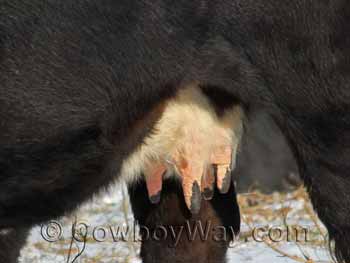
A mare is a female horse. Externally, her udder is made up of two halves, or sides, each with its own teat.
In comparison, cow udders are made up of four quarters (each with its own teat), not two halves.
Below: A mare's udder showing two teats.
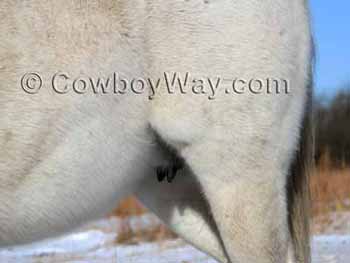
Below: A cow's udder showing four teats.
Mules and Hinnies
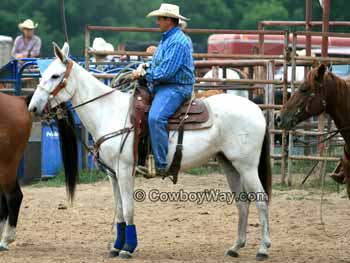
- A mule is a cross between a male donkey (called a jack) and a female horse
(called a mare). Male mules are called johns and
females are called mollies.
Even though male and female mules are almost always sterile, male mules are routinely castrated (gelded) in order to prevent the behavioral problems inherent in many studs. - A hinny is a cross between a male horse (called a stallion) and a female donkey (called a jenny). Like mules, hinnies are almost always sterile.
Below: A mule.
Speaking of Donkeys...
In the information above we mentioned that a mule was a cross between a male donkey and a female horse; and that a hinney was the cross between a male horse and a female donkey. Which brings us to...donkeys.
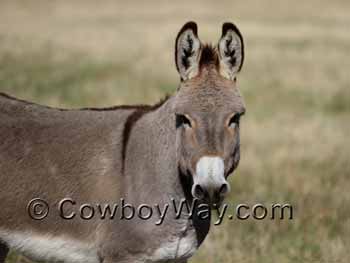
A donkey is a relative of the horse. A donkey's scientific classification is Equus africanus asinus while a horse is Equus ferus caballus. A donkey can also properly be called an "ass."
And then there are burros, which look a lot like donkeys. That's because a burro and a donkey are the same thing. A donkey and a burro are both classified as Equus africanus asinus which means they are one and the same.
However, it's not uncommon for regional or cultural differences to use the words differently. For example, some people say "burro" when they're talking about a small donkey. And some people say "donkey" when they're talking about a domesticated individual or group, but say "burro" when referring to their feral ("wild") counterparts.
Below: A donkey, or burro.
Lips and Nostrils
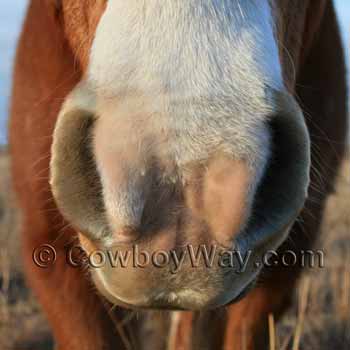
- Horses have a prehensile upper lip. Prehensile means "adapted for seizing, grasping, or taking hold of something." Their upper lips are very sensitive and capable of feeling the smallest of differences in objects.
- Horses with typical anatomy are "obligate nasal breathers" which means they must breathe through their nostrils and cannot breathe through their mouths.
Below: A horse's upper lip and nostrils.
Nasolacrimal Ducts
The "nasolacrimal duct" is a tear duct that drains tears from the corner of a horse's eye, down the nose through the nasolacrimal duct, and out through an opening at the bottom of the nose. This opening is usually visible to the naked eye inside the horse's nostril.
Below: The yellow arrow is pointing to the nasolacrimal duct inside the left nostril of a horse.
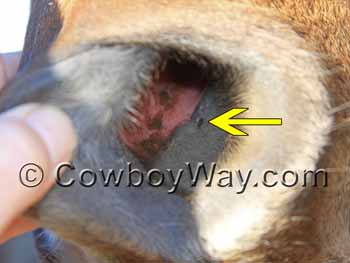
In some cases the nasolacrimal duct can become damaged or blocked. In unusual cases, a horse is sometimes born without an opening for the nasolacrimal duct in the nostril. In these cases symptoms commonly include excessive tearing in the corner of the eye. For more information, you can see this page: What Is The Nasolacrimal Duct In Horses?
Happy Birthday!
All horses, regardless of when they were actually born, are considered to have a common birthday. In the Northern Hemisphere they celebrate a common birthday on January 1; in the Southern Hemisphere the common birthday is August 1. This is one of the reasons most horsemen don't like their foals to be born just before those dates: Even if a foal is born only the day before he or she will have their first birthday the very next day.
More
Scientists believe that the first known ancestor of the horse lived about 50 million years ago. This prehistoric horse is called Eohippus and had four padded toes on the front legs and three padded toes on the back legs. Eo means "dawn" and hippus means "horse," so Eohippus is "dawn horse."
Splint Bones
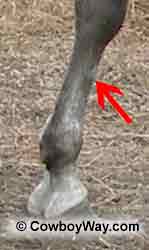
A horse's splint bones are thought to be remnants of toes from prehistoric horses. The splint bones are small bones (about the size of a pencil at the top and tapering down to be much smaller) found on each side of the cannon bone.
In the photo below the red arrow is pointing to a small bulge that is a splint bone that has "popped." This happens when the splint bone becomes detached from the cannon bone. A splint might become detached due to a nutritional imbalance or trauma. It is usually not a cause for concern.
In most cases a popped splint will cause mild pain to the horse right after it separates from the cannon, but when the splint has "set" or healed it is completely pain free and is not a health or soundness concern.
Zebroid
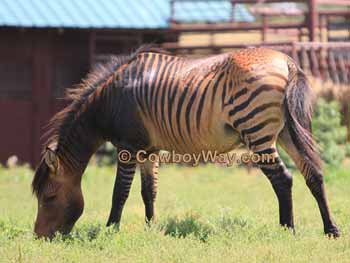
A zebroid is a cross between a zebra and any other member of the family Equidae (which, besides zebras, includes donkeys, ponies, and horses).
- A "zonky" is a cross between a zebra and a donkey.
- A "zony" is a cross between a zebra and a pony.
- A "zorse" is a cross between a zebra and a horse.
Below: A zony.
What Is / Are...
… What Are 5 Of The Biggest Wild West Robberies?
… What Are 5 Reasons Horse Trailer Lighting Matters?
… What Are 8 Dumb Things To Say To A Horse Lover?
… What Are 9 Proven Ways To Keep Flies Off Horses?
… What Are Chestnuts and Ergots?
… What Are The Parts Of A Western Saddle?
… What Are Saddle Rigging Positions?
… What Are Some Fencing Options?
… What Are Some Foods Both Horses And Dogs Can Eat?
… What Are Some Horse Fencing Basics?
… What Are Some Interesting Horse Facts?
… What Are Some Interesting Charts and Graphs With Horse Information?
… What Are Some Options For Temporary Horse Fencing?
… What Are Synthetic Saddles Made Of?
… What Are The Rodeo Catch Pens?
… What Are The 10 Best 3-Horse Trailers With Living Quarters In The USA And Canada?
… What Are The X's In A Cowboy Hat?
… What Are The Three Legal Head Catches?
… What Is The Angle System For Branding?
… What Is The Barrel Racing Pattern?
… What Is A Bull Riding Vest Made Of?
… What Is Deworming Your Horse?
… What Is A Domain Name?
Why would I need one for my farm or ranch even if I don't have or
want a website?
… What Is A Fifth Wheel Trailer Hitch?
… What Is Flag and National Anthem Etiquette At A Rodeo?
… What Is A Slant Load Horse Trailer?
… What Is Floating A Horse's Teeth?
… What Do Horse Freeze Brands Look Like?
… What Is A Galvayne's Groove?
… What Is A Gooseneck Trailer Hitch?
… What Is Some History About The First National Finals Rodeo?
… What Is The History Of The Modern, Hornless, Bronc Riding Saddle?
… What Is The History Of The Modern Rodeo Bucking Chute?
… What Is The History Of The One-Hand Bareback Rigging?
… What Is The Nasolacrimal Duct In Horses?
… What Is A Pony Express Mochila?
… What Is Hermann Oak Leather?
… What Is Larvicidal De-Worming?
… What Is The Flehmen Response?
… What Is The Rodeo Return Gate?
… What Is A Safety Tip For Posting The Colors?
… What Is A Slick Fork Saddle?
… What Is A Swell Fork Saddle?
You Might Also Like