Cowboy Dictionary
Welcome to the CowboyWay cowboy dictionary! W have definitions for words, terms, and expressions common to a cowboy or horse lifestyle. Many definitions are illustrated with photos
You can:
- Click on a letter to search for cowboy definitions that start with that letter.
- Or, you can scroll down this page for the definitions.
|
Around The Horns - In team roping and some other competitive roping events, around the horns is one of three legal head catches. Around the horns is sometimes called a "horn catch" or "a clean horn catch." The other two legal head catches are a half head, and a whole head (sometimes called "around the neck"). An around the horns catch is pictured at right. The loop goes in front of and behind both horns. At right: An around the horns catch, one of three legal head catches in team roping and some other competitive roping events. |
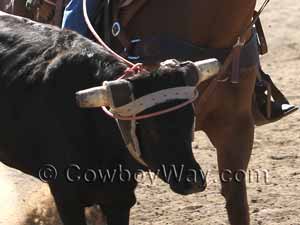
![]() |
Bangs - A casual or slang term for the disease Brucellosis in cattle. The terms "banger" and "banged out" are used to describe cattle that have tested positive for Brucellosis.
Barrel Racing - A competitive event in which a horse and rider run a cloverleaf pattern around three 55-gallon barrels. It is a timed event in which the fastest time wins. Though most recognized as a sport competed in by women, depending on what (if any) governing body sanctions a barrel race the rider might be male or female.
|
Barrel Racing Pattern - The pattern, or order, in which a
barrel racer must gallop their horse around three 55-gallon barrels during the
barrel racing event. The rider has the choice of turning either the right or left barrel first. It is most common to take the right barrel first because most horses are naturally more athletic when working to their left. By taking the right barrel first the horse will have one right-hand turn (the first barrel), and two left-hand turns (the second and third barrels). If a barrel racer does not go around the barrels in the correct order, it is called "breaking the pattern" and results in a no time. At right: This illustration shows shows the barrel racing pattern with the right barrel being turned first. |
![]() |
|
Barrier - In rodeo, a barrier is a device used in the roping
and steer wrestling events to allow the calf or steer a head start. The barrier has two parts. One part goes around the neck of the calf or steer, and the other part is a rope stretched across the front of the roping box. When the calf or steer runs into the arena and reaches the end of their pre-determined head start (called the "score"), the part of the barrier around their neck triggers the release of the barrier rope in front of the roping box, allowing the roper or steer wrestler to begin pursuit. Almost simultaneously, the part of the barrier around the neck of the calf or steer breaks away so they can continue down the arena. However, if the roper or steer wrestler begins pursuit too early, they will run into the rope across the front of the roping box. This rope is actually two separate pieces that are tied together with string, and when it's run in to the string breaks. This is called "breaking the barrier" and the roper or steer wrestler is given a time penalty (usually 10 seconds). |
![]() |
|
Above right: The yellow highlights illustrate the part of the barrier around the neck of the steer, and the part that stretches across the front of the roping box. |
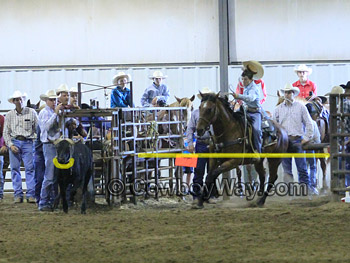
|
• Back to the top •
Batwing Chaps - Batwing chaps, or "batwings," are a type of leather leg covering worn by cowboys and cowgirls for protection against weather, trees, brush, kicks, rope burns, and other hazards. For a picture of batwing chaps please see our page Cowboy Dictionary - Letter C and look for the definition of "chaps."
You can shop for batwing chaps here.
|
BLM Brand - A brand registered to the Bureau of Land Management
(BLM), an agency of the United States Department of the Interior.
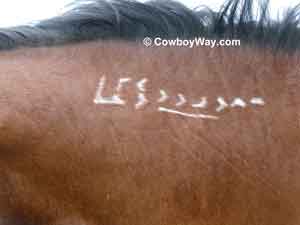
A BLM brand is perhaps best known as the brand found on some feral horses (aka "mustangs") in the United States. The BLM applies their brand to the left side of the horse's neck. The brand begins with a special character to indicate the brand is registered with the BLM. After that, there is a series of the same character, turned at different angles, with each angle representing a different number. We explain a BLM brand in greater detail here: The Angle System For Branding. At right: A BLM brand on a horse. |
![]() |
|
Bosal - A piece of equipment put on a horse's head to communicate with it while it is being ridden. A bosal, when used with a hanger and mecate, is called a hackamore. The three main parts of a hackamore are:
|
![]() |
|
You can shop for bosals here. |
Above: A hackamore. |
|
Brand - A permanent mark on the hide of an animal. A brand is used for identification of ownership. A brand can be a hot brand (made with a hot branding iron) or a freeze brand
(made with a very cold branding iron). For more information: For even more information about freeze brands, please see our articles What Is Freeze Branding? and Freeze Branding Horses. |
Above: A hot brand on a horse.
Above: A freeze brand on a horse. |
Branding Iron - The tool used to make a brand on the hide of an animal.
Bred Cow - A cow that is currently bred, or pregnant.
|
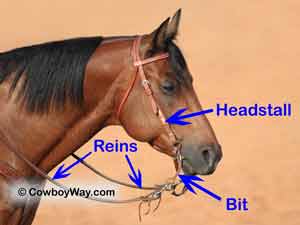
Bridle - A piece of equipment put on a horse's head to communicate with it while it is being ridden. A bridle is made up of two basic parts: 1) a headstall, and 2) a bit (or related piece of equipment). The headstall's primary job is to hold the bit in place, but the headstall can also impart a "feel" and communicate to the horse from the rider. The bit, nose piece, or other piece of equipment that makes up a bridle is also a communication piece, and is connected from the headstall to the rider's hands through an additional piece of equipment called "reins." While a headstall and a bit are collectively known as a bridle, headstalls and bits are almost always sold separately. There is a wide variety of both headstalls and bits, and each piece is purchased separately to meet the specific needs and preferences of different horses and riders. |
![]() |
You can shop for headstalls here.
You can shop for Western horse bits here.
You can shop for English horse bits here.
|
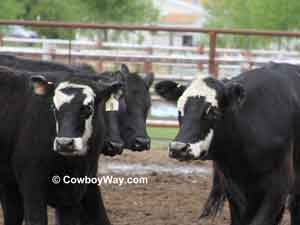
Brock Face - A facial marking in cattle where there are patches of white hair and patches of hair of another color. Also called "brockle face," "mock face," and/or "mockle" face. A brock face can be further described according to the color of the non-white hairs, as in "black brock face" (BBF) or "red brock face" (RBF). At right: In front are two black brock face heifers. |
![]() |
Broke Horse - A horse that has been trained to be ridden. A horse might be further described as "green broke" (the horse's training is not yet complete) or "kid broke" (considered to be gentle and safe for inexperienced riders).
Bronc - A horse that volunteers to buck well and consistently. A bronc might be a member of a rodeo bucking string, or a saddle horse that is known to buck hard and regularly. Horses that buck the first couple of times they are ridden, or horses that have not yet been trained to be ridden, are not properly referred to as broncs. "Bronco" means the same things as "bronc."
|
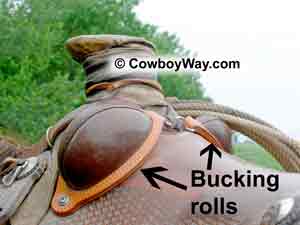
Bucking Rolls - Bucking rolls are a piece of equipment sometimes added to the front of a saddle to help a rider stay secure during bucking or other rough riding. Bucking rolls are most commonly found on "slick fork" styles of saddles. The fork (also known as the "swells") is the area of the saddle to the left and right of the saddle horn. While having a saddle with a slick fork (or low swells) has certain advantages in some situations, it can also sometimes allow for too much movement for the rider during bucking or other rough riding. Bucking rolls add swells to a saddle, taking up some of the open space to help a rider remain secure in tricky situations. Bucking rolls are easily attached and removed, allowing a rider to modify their saddle when the need arises. You can shop for bucking rolls here. At right: Bucking rolls. |
![]() |
Bull - An un-castrated male animal belonging to the genus Bos, which includes the species cattle.
• Back to the top •
Calf - A young animal belonging to the genus Bos, which includes the species cattle. A calf can be either male or female. The plural of "calf" is "calves."
|
Camouflage - The ability blend in with surroundings in order not to be noticed. In the animal kingdom, camouflage is an important safety factor many animals use in order to hide from predators. At right: A Brahman, Simmental cross calf lies camouflaged in the grass. |
![]() |
Cattle - An animal belonging to the family Bovidae, genus Bos, and species cattle. "Cattle" is a plural term used to refer to more than one animal.
|
Cattle Guard - A device set into the ground designed so that vehicles can drive over it, but livestock will not want to cross it. At right is a common style of cattle guard. A hole was dug into the ground, then the cattle guard, a series of heavy, 2 inch pipes with gaps in between them, was set over the hole. At right: A cattle guard. |
![]() |
Chaps (pronounced "shaps") - Leather leg coverings worn by cowboys and cowgirls for protection against weather, trees, brush, kicks, rope burns, and other hazards.
There are two common styles of chaps: Shotgun and batwing. Both styles buckle around the waist and are open in the back so a rider's seat is not covered. After that, there are several differences.
- Shotgun chaps get their name from their straight design, similar to a shotgun barrel. They are the original style of chap for working cowboys. Shotgun chaps run the full length of the leg, and are typically closed around the leg from top to bottom. Modern shotgun chaps are usually made with a zipper or other fasteners running from the top of the leg to the bottom to make them easy to put on and take off. Older shotgun chaps - or new ones designed on an older style - might be enclosed from top to bottom requiring the rider to step into them like a pair of jeans.
- Batwing chaps are a style that came along after shotgun chaps. Batwings also run the full length of the leg, but are typically only closed around the leg from the top of the chap to just above the knee. Buckles, snaps, and other fasteners are common. Batwing chaps are fuller cut than the shotgun style, having a generous amount of leather that overlaps the leg.
![]() |
![]() |
|
|
Above: Shotgun chaps |
Above: Batwing chaps |
You can shop for chaps here.
|
Chestnuts - Horse chestnuts are normal, healthy growths found on most horse's legs. No one really knows why they exist, and they have been a subject of curiosity among horsemen for quite a long time. Chestnuts appear on the front legs of a horse above the knee, or on the back legs of a horse below the hock. They can be large or very small. Some people call horse chestnuts "night eyes." At right: A close-up look of a horse chestnut on a horse's front leg. |
![]() |
For more information about horse chestnuts, please see our article What Are Horse Chestnuts and Ergots?
|
Chinks - Leather leg coverings. Chinks are worn by cowboys and cowgirls for protection against brush, kicks, rope burns, and other hazards inherent to a cowboy lifestyle. Chinks are similar to chaps. Both chinks and chaps are buckled around the waist and are open in the back so a rider's seat is not covered. Chinks, however, are shorter than chaps, stopping somewhere between the knee and ankle instead of running the full length of the leg. Chinks are also usually designed to be fairly open behind the leg, whereas chaps, depending on the type of chap and their design, might be fully enclosed behind the leg. The fringe on chinks is also usually longer and more prominent than fringe found on chaps. Whether a cowboy or cowgirl chooses to wear chinks or chaps is a decision sometimes based on weather (chinks are more commonly worn in warm weather), style associated with certain locales, or personal preference. At right: Chinks. |
![]() |
You can shop for chinks here.
• Back to the top •
|
Clotheslined - Running into, or being ran into by, a solid object. For example, if a rider gallops under a tree and runs into a branch, an observer might say: "Wow, he sure got clotheslined by that tree limb." Working cowboys and cowgirls are sometimes clotheslined by ropes. If a roper catches a calf (or cow, etc.) and dallies, the rope between the calf and the horse can become a potential hazard. Other nearby riders or a ground crew on foot are sometimes clotheslined with the rope, spooking horses, or knocking people down. To get clotheslined is usually an embarrassment for the roper and/or the other riders or persons that get clotheslined. Cowboys in and out of the saddle take pride in understanding, and avoiding, the potential dangers involved with roping. At right: A cowboy getting clothslined. |
![]() |
Above and to the right is a photo of a ranch rodeo contestant getting clotheslined in the wild cow milking event. While getting clotheslined is often an embarrassment for a cowboy, we think a case like this is an exception. This was a cowboy who knew the risks but was willing to take chances in order to get a fast time for his team. After he was knocked off his feet he still hung onto the rope and slowed the cow so his teammates could catch up.
Cold-Backed (Definition 1 of 2) - A horse that is broke to ride, but bucks when ridden for first time that day or after a layoff of several days or longer.
Cold-Backed (Definition 2 of 2) - A horse with an overly sensitive or painful back.
Colt - A colt is a young male horse, 4 years old or younger.
|
Cow (Definition 1 of 2) - A mature female animal belonging to the genus Bos, which includes the species cattle. Some females of other large animals, such as elephants and whales, are also called cows.
At right: A Texas Longhorn cow |
![]() |
- Cows are ruminants. A ruminant is an even-toed animal that digests its food
by first swallowing it, then regurgitating it later to re-chew and re-swallow
it. This process may be repeated several times.
- The regurgitated food is referred to as a "cud."
- Ruminants have four different digestive chambers. The chambers are the rumen, reticulum, omasum, and the obamasum.
- Ruminant animals like cows are very efficient at extracting the most nutrition possible from poor quality feed.
- More examples of ruminants include goats, sheep, deer, llamas, bison, and buffalo.
- The gestation period for a cow is nine months
- Some common "cow" terms:
- Cattle - An animal belonging to the family Bovidae, genus Bos, and species cattle. "Cattle" is a plural term used to refer to more than one animal.
- Calf - A young member of the genus Bos. A calf can be either male or female. The plural of "calf" is "calves."
- Heifer - A young female member of the genus Bos. When a heifer matures, she is called a cow.
- Cow - A mature female belonging to the genus Bos.
- Bull - A male belonging to the genus Bos.
- Steer - A castrated male belonging to the genus Bos.
- Ox - A male belonging to the genus Bos that has been castrated after having reached sexual maturity. The term can also mean any member of the Bos genus (usually male, but can also be female) that is used for draft work. The plural of "ox" is "oxen."
While the word "cow" is properly used to define a mature female, among cowboys and others in the livestock industries the term is sometimes used to loosely describe any member of the cattle species. For example, a "cow sale" is a sale that sells cows, but it might also sell bulls, calves, and/or steers and heifers. When used like this the the term "cow" is slang for any bovine, and its usage is not considered to be incorrect.
- You can look at cow pictures here.
You can shop for cow posters here.
Cow (Definition 2 of 2) - A way of describing a horse's innate ability to read and handle cattle. For example: "That horse sure has a lot of cow," or " That horse is sure cowy". Not all horses have cow, and among cowboys and cowgirls describing a horse as having cow, or being cowy, is a compliment.
• Back to the top •
Cowboy - Someone who takes care of cattle, primarily on horseback. Cowboys typically have excellent horsemanship and roping skills, and an extensive knowledge of horse and cattle husbandry.
Cowgirl - A female cowboy.
|
Crupper - A strap that runs from the back of the saddle or
harness along the top of a horse or mule's rump, then underneath the tail.
The purpose of a crupper is to keep the saddle or harness from sliding
too far forward.
You can shop for cruppers here. At right: A crupper. |
![]() |
|
Crow Hop - A style of bucking where a horse arches its back and takes short, stiff hops. All four legs come off the ground, but usually not very far; with some horses the back legs barely clear the ground. When a horse crow hops all four legs hang straight down, i.e., the horse does not kick up high with the back legs. Crow hopping is usually considered a milder form of bucking. For example: "My horse didn't buck hard today, he just crow hopped a little." However, it can still be dangerous and many riders have been bucked off by crow hopping horses. At right: A horse crow hopping. |
![]() |
|
Dally - A "dally" is a wrap, or a series of wraps, around a saddle horn with a rope. After cowboys and cowgirls rope something (such as a cow, calf, etc.) they often dally the other end of their rope to their saddle (specifically, the saddle horn) as a means of holding whatever it is they have roped. Dallying can be contrasted with "tying hard," where the rope is fastened (not dallied) to the saddle horn, often with the use of a "horn knot." You can see the definition of a horn knot lower on this page. At right: Two wraps, or dallies, around a saddle horn. |
![]() |
Dam - The term give to a mare (female horse) when she becomes a mother.
Day Work - Working for a ranch on an as-needed or day-by-day basis.
|
Dorsal - In animals that have a backbone the
"dorsal" side of the animal is the side that lies closest to the backbone. In a
horse, cow, dog, or cat, for example, this is the side that is the top of the neck, the back, and the top of
the rump. Another way of putting it is that the dorsal side is the
side we normally think of as the "top" or "up" side. Some animal colors are described as having a "dorsal stripe." A dorsal stripe is a stripe of color darker than the other surrounding body hairs that runs along the animal's dorsal side. At right: The red arrow is pointing to a dorsal stripe on a horse. |
![]() |
• Back to the top •
Eared Cattle - A cow, bull, etc. that has large and/or thin-hided ears due to the influence of Brahman cattle in their breeding. For example: "He runs cows that have a lot of ear" or "He runs a lot of eared cows."
|
Ear Tag - A tag placed in the ear of livestock to help the owner distinguish it from other animals in the herd. Ear tags are commonly used in cattle, sheep, and other livestock (with the exception of horses). Ear tags help a herd owner or manager distinguish one animal in the herd from the others, and greatly aid in accurate record keeping. The exact information that can be found on an ear tag is up to the owner or manager of the livestock, and varies from one ranch or herd to the next. Individual, identifying numbers are commonly found on ear tags, and sometimes the year or date of birth, a herd number, and/or other useful information. At right: A black cow with a blue ear tag in her left ear. |
![]() |
|
Ergots - Normal, healthy growths found on most horse's legs. No one really knows why they exist, and they have been a subject of curiosity among horsemen for quite a long time. Ergots are found on the back of the fetlock on all four legs, and are usually covered by hair. When you feel them, they feel a lot like an eraser on the end of a wooden pencil. For more information about ergots, please see our article What Are Horse Chestnuts and Ergots? At right: The yellow circles indicate where ergots can be found. |
![]() |
Ermine MarksErmine marks are black or dark spots on horses that appear in white markings just above the hoof. At right: A horse with ermine marks. |
![]() |
|
Feathers - On horses, the word feathers refers to the long hairs on the back of the lower legs. Not all horses have feathers. Feathers are a common characteristic of draft horses. Horses that have feathers also commonly have "spats," which are long hairs that hang down over the hooves. At right: The blue arrows are pointing to feathers, and the red arrows are pointing to spats. |
![]() |
|
Float - The word float can be both a noun and a verb. It can refer to the tool used to rasp a horse's teeth, or it can refer to the rasping itself. Floating a horse's teeth means to file or rasp their teeth to make the chewing surfaces relatively flat or smooth. The type of file used for this is called a "float," which is where the procedure gets its name. For more information about floating a horse's teeth, please see our article Floating A Horse's Teeth. At right: A tooth float in a bucket of disinfectant. |
![]() |
Foal - A newborn or very young horse, male or female.
|
Freeze Brand - A brand is permanent mark on the hide of an animal, and is used for identification of ownership. A freeze brand is made by using a very cold branding iron (as apposed to a hot brand which uses a hot branding iron). The process of freeze branding uses extreme cold to kill the cells in the animal's skin that produce pigmentation, or color. Therefore, a freeze branded animal will have white hair where the freeze branding iron touched the skin. For more information about freeze brands, please see our articles What Is Freeze Branding? and Freeze Branding Horses. At right: A freeze brand on the right hip of a horse. |
![]() |
• Back to the top •
Gelding - A male horse that has been castrated, or gelded.
Green Broke - A horse that is trained to be ridden, but that is inexperienced and whose training is not yet complete. For example: "That's a nice horse, but he's just green broke," or "He's coming along well, but he's still pretty green."
|
Hack Rein - A hack rein is a long, thick rein used by certain types of competitive bronc riders. The hack rein is attached to the bronc's halter, and the bronc rider holds on to it during the bronc ride. Saddle bronc riders use a hack rein in competition, but bareback bronc riders do not. To learn more about the differences between saddle bronc riding and bareback bronc riding, please see this page: Saddle Bronc Riding Vs. Bareback Bronc Riding (the article is beneath the photos). To learn about another competitive bronc riding event that uses a hack rein, please see this page: About Ranch Bronc Riding (the article is beneath the photos). At right: A rider competing in ranch bronc riding uses a hack rein. |
![]() |
|
Hackamore: A piece of equipment put on a horse's head to communicate with it while it is being ridden. A hackamore consists of a bosal, a hanger, and a mecate.
At right: A hackamore. |
![]() |
You can shop for hackamores and bosals here.
Half - When referring to acreage, a "half" is a half section of land. A full section of land is 640 acres, so a half section is 320 acres.
• Back to the top •
|
Half Head: In team roping and some other competitive roping events,
a half head is one of three legal head catches. The other two legal head catches are a whole head (sometimes called "around the neck"), and around both horns (sometimes called a "horn catch" or "a clean horn catch"). A half head catch is pictured at right. The loop goes behind one horn, underneath the chin, and in front of the other horn. At right: A half head catch, one of three legal head catches in team roping and some other competitive roping events. |
![]() |
|
Halter - A head collar for leading, tying, and general handling of horses and cattle. In horses, a halter is commonly used so the handler can catch, lead, tie, hold, transport, or handle the horse in any manner. A "lead rope" is a rope that attaches to a halter, whether temporarily or permanently, and gives the handler a lead to hold on to and use for directing the horse. A horse that willingly accepts a halter and allows itself to be led by the handler is called "halter broke." In cattle, a halter is commonly used for the same reasons as in horses. However, it is far less common to halter break cattle than horses. Cattle that are commonly halter broke are those that compete in the show ring. At right: A horse wearing a style of halter called a "rope halter." The lead rope can be seen coming down from the bottom of the halter. |
![]() |
You can shop for horse halters here.
|
Hand - A unit of measurement for measuring horse height. One hand is equal to four inches. To measure horse height a horse is measured from the ground to the highest point of its withers. This measurement, taken in inches, is converted to hands to describe a horse's height. We have a more detailed article on "hands" and how to measure horse height here. At right: The height of a horse is measured from the ground to the highest point of its withers. |
![]() |
Headstall - A headstall is a hanger put on a horse's head used for holding a bit, bosal, nose piece, or other piece of equipment to control a horse while riding. When a headstall is combined with a bit (or bosal, nose piece, etc.) the combination is known as a bridle. For more information about headstalls, please see our article "The Main Parts of a Headstall" (the article is beneath the headstalls for sale).
You can shop for headstalls here.
Heifer - A young female belonging to the genus Bos, which includes the species cattle. When a heifer matures, she is called a cow.
One example of using the word heifer: "One of the cows had a heifer calf last night." This lets it be known that the cow gave birth to a female calf, as opposed to a bull (male) calf.
The term heifer is often used to describe young females up to 1-2 years of age. After that she is usually expected to give birth to her first calf, and then is referred to as a cow. One exception to this is a "first calf heifer." A first calf heifer is a young female that is pregnant with, or given birth to, her first calf. She is described as a first calf heifer, instead of a cow, in order to let it be known she is still a young animal.
• Back to the top •
|
Honda - A honda is the small loop at the end of a lasso or lariat type of rope. When the opposite end of the rope is passed through the honda, a larger loop is created. This larger loop is used by cowboys and cowgirls to rope cattle. A honda can be made by forming a small loop in the end of the rope, then tying the loop in place with a special knot (a honda knot). A honda might also be a separate piece that is added to the rope. This type of honda might be made of metal, braided rawhide, or other materials. At right: The blue arrow is pointing to a honda. |
![]() |
- To learn how to tie a honda knot, please see our article How To Tie A Honda Knot.
|
Horn Knot - A "horn knot" is a small piece of equipment used for attaching a rope to a saddle horn. A horn knot is used when the roper wants to "tie hard" instead of dallying. (You can see the definition of dallying higher up on this page.) In the photo at right, the horn knot is the metal object, not the knot you see in the rope. A horn knot can be made of a variety of different materials such as metal, braided nylon or rawhide, plastic, and others. For more information about horn knots, including how to put one on your rope, please see this page: How To Put A Horn Knot On A Rope. |
Above: A metal horn knot. |
|
Horns - Horns are growths that protrude from the skulls of some animals in the family Bovidae. Horns are made of bone and keratin. Animals that have horns include cattle, sheep, goats, gazelles, antelope, bison, and buffalo. As stated above, horns are made of bone and keratin. The bone is the center, or core, of the horn and is fused to the bone of the skull. The bone core is covered by a resilient sheath (protective covering) made of keratin. Horns are a permanent part of the animal, which means the horns an animal is born with are the same horns it has its entire life. In other words, horns are not shed and re-grown like antlers. |
Above: A Longhorn cow skull. On the right-hand side of the photo the keratin sheath that protects the bone core of the horn has slipped off and is lying on the ground beside the skull. |
Some people are under the mistaken impression that only male animals can have horns, but in cattle as well as some other species both males and females can have them.
For more information about horns, please see our article Cow Horns.
|
Horse - A hoofed mammal best known for being used by humans as a riding animal, beast of burden, and companion. The domesticated horse is classified by science as being:
At right: A horse |
![]() |
Common horse terms include:
- Colt - A young male horse, 4 years old or younger
- Filly - A young female horse, 4 years old or younger
- Foal - A newborn or very young horse, male or female
- Gelding - A male horse that has been castrated, or gelded
- Mare - A mature female horse
- Stallion - A male horse that has not been castrated
- Dam - The term give to a female horse when she becomes a mother
- Sire - The term given to a stallion when he becomes a father
For interesting horse facts and trivia, please see our article Horse Facts and Interesting Horse Trivia.
Horse Colt - "Horse colt" is another way of saying "colt," which is a young male horse, 4 years old or younger. In casual conversation some people refer to any young horse, or a young horse of unknown gender, as a "colt," so the term "horse colt" is sometimes used to make sure there is no misunderstanding that the young horse is a male.
• Back to the top •
|
Hot Brand - A brand is permanent mark on the hide of an animal, and is used for identification of ownership. A hot brand is made by using a hot branding iron (as apposed to a freeze brand which uses a very cold branding iron). At right: A brand on a horse. |
![]() |
|
Hypsodont Teeth - Hypsodont teeth are teeth with high crowns that slowly continue to emerge from the gum for most of the animal's life. As the top of the tooth is worn down, more tooth slowly erupts from the gum line to replace what has been worn away. Horses and other grazing animals like cattle and deer have hypsodont teeth. At right: A horse skull with teeth. |
![]() |
|
Interdental Space - An area in a horse's mouth, both on the upper and lower jaws, where there is not any teeth. The interdental space is between the front teeth (the incisors) and the back teeth (the molars). When a horse is bridled, the interdental space is where the bit rests. On the bottom jaw, most horsemen refer to this area of bare gums as the "bars." At right: The yellow arrows are pointing to the interdental space. |
![]() |
|
Kid Broke Horse - A horse that has been trained to be ridden and is considered to be gentle and safe for inexperienced riders of any age. At right: A kid broke horse. |
![]() |
Lariat - A rope used by cowboys and cowgirls for roping cattle. Most cowboys and cowgirls simply refer to a lariat as a "rope." A lariat is also called a lasso.
Lasso - The word lasso can be both a noun and a verb. It can refer to the rope used by cowboys and cowgirls to rope cattle ("Don't forget to put your lasso on your horse"), or it can refer to the act of roping itself ("She sure lassoed that steer quick."). Most cowboys and cowgirls simply refer to a lasso as a "rope," both as a noun and a verb ("Don't forget to put your rope on your horse" or "She sure roped that steer quick.") When used as a noun, a lasso is also called a lariat.
• Back to the top •
|
Latigo (Definition 1 of 2) - A strap, usually made of leather or nylon, used for securing a saddle onto a horse. A latigo is found on the left side of the saddle. It is attached to a "D" ring on the saddle, then is laced through the front cinch to secure the saddle to the horse. Latigos have been traditionally made of leather. Today, however, nylon latigos are also common. At right: The blue arrow is pointing to a latigo. |
![]() |
Latigo (Definition 2 of 2) - A type of leather.
Mare - A mature female horse.
|
Mark Out Rule - A rule used in the rodeo events of saddle bronc riding and bareback bronc riding that requires bronc riders to have the rowels of both spurs in front of, and touching, the break of the bronc's shoulders on its first move out of the chute. The rider's feet must still be in this position when the bronc's front feet hit the ground for the first time. This is called "marking a horse out." For more information about the mark out rule, please see our article The Mark Out Rule. At right: This saddle bronc rider's left foot is in the required position to mark the bronc out. His right foot cannot be seen in the photo, but needs to be in the same position on the right side. His feet must remain in this position until the bronc's front feet hit the ground for the first time. |
![]() |
|
Mecate - A type of rein, which is a piece of equipment used for communicating with a horse while it is being ridden. Although mecates are sometimes used with other types of equipment, such as a bit, their traditional use is with a bosal. Mecates are made in one long piece, which, when they're not tied to a bosal, makes them resemble a rope. When properly tied to a bosal a mecate will have two main parts: 1) a loop that goes over the horse's head to make a rein on each side of the neck and 2) a lead that is used to lead the horse with from the ground. Although mecates have traditionally been made of horsehair they are also made from nylon or other synthetic materials. The nicer horsehair mecates are made from mane hair, but some are made from tail hair, which is coarser. |
![]() |
|
Above: A mecate. |
• Back to the top •
|
Medicine Bags - A type of saddle bag designed to hold medicine and supplies for doctoring cattle in the pasture. Medicine bags come in a variety of styles and designs. They are typically designed to hold such items as a syringe, bolus gun, and medicines for treating sick cattle after the cowboy has roped them in the pasture. At right: Medicine bags. |
![]() |
|
Muley - A casual or slang term for "polled," which means an animal that is naturally, or genetically, without horns. An animal that was born with horns but had them removed at some point would be described as "dehorned," not polled. For more information about horns, please see our article Cow Horns. At right: A polled, or muley, cow. |
![]() |
|
Mutton Bustin' - An event in which children ride sheep. Mutton bustin' is an event usually reserved for children too young to compete in other events commonly associated with the sport of rodeo. In mutton bustin' the sheep are released from bucking chutes similar to the way a bronc or bull is released from a bucking chute. However, the sheep do not buck, but instead walk, trot, or run down the arena. One or more adults are in the bucking chute with the child to hold onto them until the bucking chute gate opens. In the case of a very young or timid child, an adult helper hangs onto the child during the ride and lifts them off before they have a chance to fall off. Older or less timid children attempt to ride on their own. Mutton bustin' is also sometimes called "wool riding." Above: A young mutton buster rides a sheep. |
![]() |
|
You can see mutton bustin' pictures here. (<<<This link will open in a new window.) |
|
Near Side - The left side of a horse. The right side of a horse is the "off" side.
|
Night Latch - A leather strap (or something similar) attached to a saddle for the rider to use when a horse is bucking. A rider grabs onto, and pulls on, a night latch when a horse is bucking to help pull themselves deeper into the saddle. A night latch is typically a leather strap, a short piece of rope, or something similar, that has been run through the gullet of the saddle. You can shop for a night latch here. At right: A pony ranch bronc rider uses a night latch. |
![]() |
• Back to the top •
Open Cow - A cow that is not currently bred, or pregnant.
Off Side - The right side of a horse. The left side of a horse is the "near" side.
Ox (Definition 1 of 2) - A male animal belonging to the genus Bos, which includes the species cattle, that has been castrated after reaching sexual maturity. The plural of "ox" is "oxen."
Ox (Definition 2 of 2) - Any member of the Bos genus (usually male, but can also be female) that is used for draft work.
|
Oxbox Stirrups - A kind of stirrup that is narrow and has a rounded or "U" shaped appearance. Oxbow stirrups (often simply referred to as "oxbows") are used by all types of horseback riders but are primarily seen among working cowboys and cowgirls. Fans of oxbow stirrups like them for several reasons, including describing them as easier to "keep" (less likely to slip out of them) during hard or rough riding than other types of stirrups. In addition, riders that prefer oxbows say that their design helps to prevent a rider's foot from hanging up when the rider is "in a storm," such as when a horse is bucking. You can shop for oxbow stirrups here. At right: An oxbow stirrup. |
![]() |
|
Pair - A way of referring to a mother cow and her calf. For example: "How many pairs did he buy?" It is sometimes a cowboy's job to "pair up" cows and calves, which means to observe them until they determine which calves belong to which cows. At right: A cow and her calf, or a "pair." |
![]() |
|
Polled - The word "polled" means an animal that is naturally, or genetically, without horns. An animal that was born with horns but had them removed at some point would be described as "dehorned," not polled. The word "muley" is a casual or slang term sometimes used to describe cattle, and means the same thing as polled. For more information about horns, please see our article Cow Horns. At right: The skull of a polled cow. |
![]() |
Quarter - When referring to acreage, a "quarter" is a quarter section of land. A full section of land is 640 acres, so a quarter section is 160 acres.
• Back to the top •
|
Rear - When a horse stands up on its hind legs. In some cases, such as with trick horses, a rear can be a controlled, trained movement performed by the horse when asked for by its rider or handler. In most other cases a rear is a wild, unpredictable movement that is dangerous for both the horse and its rider, or other people on the ground nearby. Photo #1: A black horse rears with a young rider. Photo #2: A roan horse rears above his fallen rider. |
![]() |
|
Reins - Reins are a piece of equipment used for communicating with a horse while it is being ridden. Reins are attached to the bridle and extend from the bridle to the rider's hands while the horse is being ridden. Reins are used to communicate such things to the horse as when to stop, turn, speed up, slow down, and more. Reins can be made of leather, horsehair, nylon, or a variety of other materials. They can be one rein (that extends from one side of the bridle, over the horse's neck, and down to the other side of the bridle), or two reins (one rein on each side of the horse's neck). What reins are made of and whether or not there is one or two depends on the riding discipline and/or the personal preferences of the rider. At right: Leather split reins (two separate reins, one on each side of the horse's neck). |
![]() |
You can shop for leather split reins here.
Remuda - A group of horses on a ranch that make up the supply of riding horses for the cowboys. The term is also sometimes used to describe any group of horses put together by someone for a specific purpose. For example, some people refer to a ranch's band (group) of broodmares as a remuda.
• Back to the top •
|
Return Gate - In a rodeo arena, the return gate is a gate near the bucking chutes that the broncs and bulls use to exit the arena. That the return gate is located where it is - near the bucking chutes - is very important. Broncs and bulls that buck while covering very little ground usually buck better - and therefore earn higher scores - than those that travel down the arena. If a bronc or bull knows that the return gate is near the bucking chutes it adds to their incentive to leave the chute and buck right where they are at, close to the gate they know they're going to use to exit the arena. On the other hand, if the broncs and bulls were to be let out of the arena through a gate at the opposite end of the arena from the bucking chutes, they would quickly learn to travel down the arena toward the far-away gate while they bucked, thereby earning lower scores for themselves and their rider. |
![]() |
|
Above: A bronc exits the |
|
Rimfire - In roping, a rimfire is when the rope that runs from the mounted roper to the roped animal comes into contact with another horse(s). Rimfires are considered dangerous and most good ropers try to avoid them. In competitive roping, the rules as to what constitutes a rimfire vary, and may be different than the definition above. Frequently, a rimfire is grounds for disqualification. Rimfire is sometimes spelled "rim fire" (two words). At right: The rope runs from the mounted rider, around the hindquarters of another horse, and to the roped steer on the other side. The horse between the roper and the steer is being rimfired. |
![]() |
Saddle Horse - A horse that has been trained to carry a saddle and be ridden.
|
Saddle Riggings - On a Western saddle, the term "rigging" can refer to the position of the front cinch, and/or to whether or not a saddle also has a back cinch (sometimes called a "flank cinch"). Here is a quick breakdown of some common rigging terms. Full Rigging: The front cinch position is the full distance from the cantle to the pommel. This puts the front cinch directly beneath the pommel of the saddle. 7/8 Rigging: The front cinch position is 7/8 of the distance from the cantle to the pommel. This puts the front cinch a little farther back than a full rigged saddle. At right: Common saddle rigging positions. |
|
3/4 Rigging: The front cinch position is 3/4 of the distance from the cantle to the pommel. This puts the front cinch a little farther back than a 7/8 rigged saddle.
Center Fire Rigging: The front cinch position is (approximately) centered between the cantle and the pommel.
Single Rigged: This means there is a front cinch, but not a back cinch (sometimes called a "flank cinch"). The term "single rigged," by itself, does not let you know the position of the front cinch (full, 7/8, etc.).
Double Rigged: This means there is a front cinch and a back cinch. The term "double rigged," by itself, does not let you know the position of the front cinch (full, 7/8, etc.).
Full Double Rigged: This means there is a front cinch and a back cinch, and that the front cinch is in the "full" position (the full distance from the cantle to the pommel).
Section - When referring to acreage, a section is 640 acres. If a section is square in shape, it is one mile long on all four sides.
Shotgun Chaps - Shotgun chaps, or "shotguns," are a type of leather leg covering worn by cowboys and cowgirls for protection against weather, trees, brush, kicks, rope burns, and other hazards. For a picture of shotgun chaps please see our page Cowboy Dictionary - Letter C and look for the definition of "chaps."
You can shop for chaps here.
Sire - The term given to a stallion (male horse) when he becomes a father.
Smooth or Smooth Mouthed - A horse nine years of age or older. In most cases, a horse's age can be ascertained by its teeth until approximately age nine. After that, the age identifying characteristics in a horse's mouth "smooth," or become less distinguished. The terms "smooth" or "smooth mouthed" are used less commonly today than in years past due to the high number of horses that are now registered with various breed organizations. With registrations keeping track of a horse's age horses can now easily be described by their actual age instead of a more general term such as smooth.
Spats - On horses, the word spats refers to the long hairs that hang down over the hooves. Not all horses have spats. Spats are a common characteristic of draft horses. Horses that have spats also commonly have "feathers," which are long hairs on the back of the lower leg. At right: The red arrows are pointing to spats, and the blue arrows are pointing to feathers. |
![]() |
• Back to the top •
|
Spur Ledge - The lip, or extension, on the back of a boot heel where a spur rests. Also called a "spur rest." At right: A spur ledge. |
|
|
At right: Spurs resting on a spur ledge. |
![]() |
Stallion - A male horse that has not been castrated.
Steer - A castrated male animal belonging to the genus Bos, which includes the species cattle.
Straw - Straw is the dry stems of certain plants. Straw is usually considered to be a by-product left over after the plant's main product, such as grain, has been harvested. After harvest the straw remaining is the field is sometimes burned, plowed under or otherwise disposed of, but it is often allowed to dry and then baled for easier transportation so it can be used for a variety of purposes. Perhaps the best-known use for straw is for animal bedding, although other products, such as sawdust, have become more common in many areas for this purpose. Other uses for straw include erosion control, construction, as a product in animal feed, crafts, and more. |
Above: A round bale of wheat straw. |
• Back to the top •
|
Stripping Chute - A chute at a rodeo arena used to take equipment off of broncs and bulls, and roping steers. At a rodeo arena there are usually two stripping chutes. One stripping chute is located near the bucking chutes and is where the broncs and bulls, after they have finished bucking, have their bareback riggins', bronc saddles, or bull flanks removed. The other stripping chute is located at the opposite end of the arena from the roping boxes. This stripping chute, sometimes called the "steer stripping chute" is where the roping steers, after they have been roped, have their head ropes and/or their heel ropes removed. At right: A steer walking into the stripping chute to have his head rope removed. |
![]() |
|
Tapaderos - Tapaderos (or "taps") are stirrups that have a hood over the front of the stirrup that covers the front part of the rider's foot. Tapaderos are sometimes called hooded stirrups. Tapaderos serve several purposes: They deflect brush to help keep the rider's foot from being pulled loose from the stirrup; they prevent the foot from being stabbed with cacti or thorns; they provide protection from weather, including to help provide extra warmth in cold weather; and they prevent the rider's foot from going through the stirrup, helping to avoid potentially serious accidents. While riders of all types sometimes ride with tapaderos, they are particularly favored among working cowboys and cowgirls, people that ride in cold conditions, and trail riders. They are also frequently used with young riders, as many parents and riding instructors feel they are an essential safety precaution to keep children's feet from accidentally going through the stirrup. |
![]() |
|
You can shop for tapaderos here. |
Above: Tapaderos. |
• Back to the top •
| Three Legal Head Catches: In team roping and some other competitive roping events, there are three legal head catches: | |
|
1 - A whole head (the loop goes behind the entire head, or around the neck). A whole head catch is sometimes called "around the neck." Whole head. |
![]() |
|
2 - Around the horns (the loop goes around both horns). This catch is sometimes called a "horn catch" or "a clean horn catch." Around both horns. |
![]() |
|
3 - A half head (the loop goes behind one horn, underneath the chin, and in front of the other horn). Half head. |
![]() |
Trap - A trap is a small pasture that serves as a temporary holding area for livestock. The size of a trap is relative to the size of the rest of the property. For example, someone who owns a small property, such as 80 acres, might consider just one acre, or even 1/2 acre, to be a trap. Someone who owns or manages a larger property of several thousand acres might consider a trap to be several hundred acres, or even several sections (a section is 640 acres).
|
Ungulate - A mammal with hooves. Horses are odd-toed ungulates and cattle are even-toed ungulates.
At right: A horse hoof. A horse has one solid (not split) hoof at the bottom of each leg. Since one is an odd number, a horse is an odd-toed ungulate. |
|
|
At right: Calf hooves. Cattle have a hoof that is split into two toes at the bottom of each leg. Since two is an even number, cattle are even-toed ungulates. |
![]() |
• Back to the top •
|
Wet Cow - A cow that is currently producing milk. A cow is wet because she has given birth to a calf. In the photo to the right you can see this cow's udder (or "bag") is enlarged with milk. She gave birth to the calf standing next to her about two months before the photo was taken. |
![]() |
|
Whole Head - In team roping and some other competitive roping events, a
whole head is one of three legal head catches. A whole head is sometimes
called "around the neck." The other two legal head catches are a half head, and around the horns (sometimes called a "horn catch" or "a clean horn catch"). A whole head catch is pictured at right. The loop goes behind the entire head, or around the neck. At right: A whole head catch, one of three legal head catches in team roping and some other competitive roping events. |
![]() |
|
Wild Rag - A cowboy or Western scarf worn around the neck. Wild rags are worn by working cowboys and cowgirls for warmth in cold temperatures, and for protection from sun, wind, and dirt anytime. In many regions wild rags are a popular fashion accessory and are a standard part of cowboy dress whether it be for work or social occasions. Wild rags come in a wide variety of colors, sizes, and fabrics. Silk is a popular fabric choice because of its light weight, softness, good looks, and other qualities. At right: A wild rag. |
![]() |
- To learn how to take care of a silk wild rag, please see our article How To Care For A Silk Wild Rag.
- To learn how to tie a wild rag, you can see our article How To Tie A Wild Rag.
You can shop for wild rags here.
Wolf Teeth - In horses, wolf teeth are vestigial premolars. "Vestigial" means something that has lost most or all of its original function through evolution. Wolf teeth are absent in most horses today, but they are not uncommon.
Wolf teeth, if present, are located in front of the other cheek teeth. They are usually found just on the upper jaw but are sometimes found on the lower jaw, too. In a riding horse wolf teeth can be a serious nuisance as they often come into contact with the bit, causing the horse discomfort or pain. For this reason, most horsemen have them removed. Since wolf teeth are typically small with poorly developed roots, they are usually quickly and easily removed.
Wolf teeth cannot always be seen. They can remain below the surface of the gum where they are called "unerrupted" or "blind" wolf teeth. However, they can usually be felt as little bumps in the gum. Blind wolf teeth often cause a horse a great deal of soreness in the mouth so they should be removed the same as wolf teeth that have erupted above the gum line. Be careful if you decide to feel for blind wolf teeth in a horse's mouth - a horse may react suddenly and violently if you touch a sore spot on its gum.
|
Zony - A "zony" is a cross between a zebra and a pony. A broader, more inclusive word to use to describe a zony is "zebroid," which is the cross between a zebra and any other equine. For example, a cross between a zebra and a pony is a zony, and a cross between a zebra and a horse is a zorse. However, they are both zebroids. At right: A zony. |
|
• Back to the top •